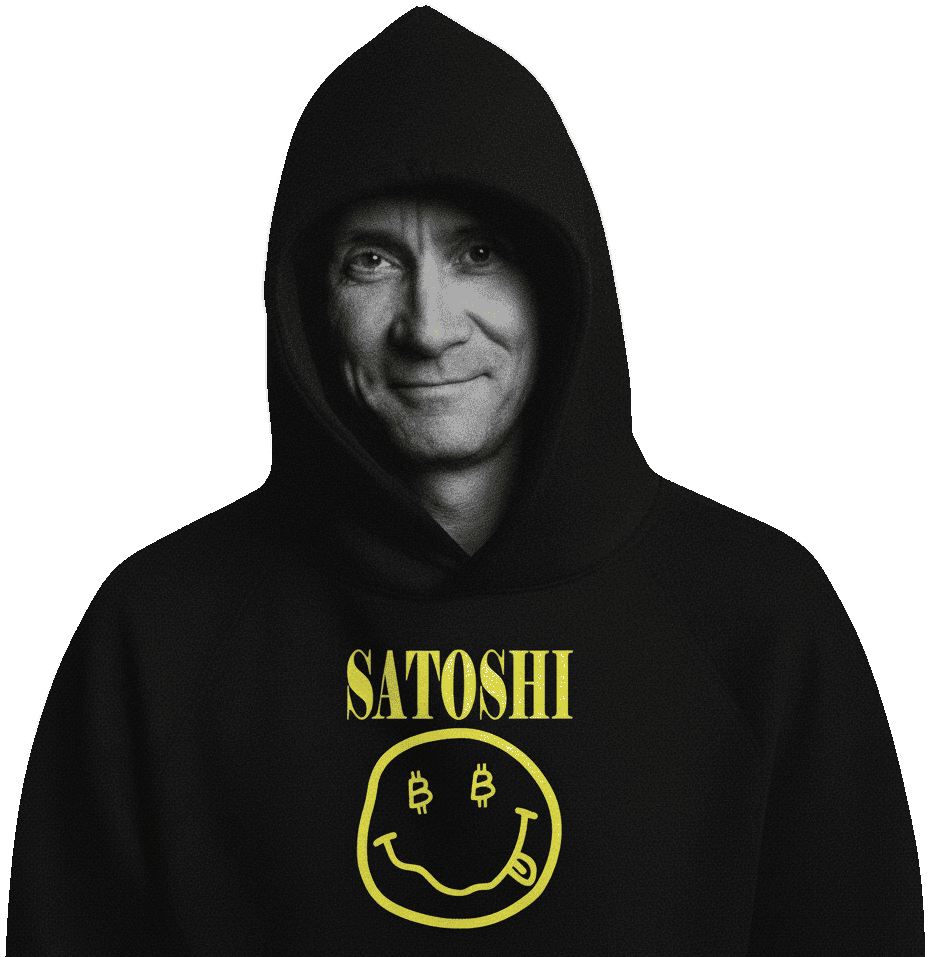
Satoshi Nakamoto
Addision Fischer
Two names, one identity?!
Who is __FULLNAME__?
- Cryptographer: __FULLNAME__ was a pioneer in public-key cryptography and digital signatures. He authored numerous papers on cryptography, co-founded RSA Data Security and other cryptography ventures, and helped shape U.S. encryption standards through his work with ANSI X9 and X12. He was also an active member of several privacy-focused organizations.
- Mathematician: From a young age, __NAME__ demonstrated exceptional talent in mathematics. Professors were impressed by his abilities while he was in high school, and at West Virginia University, he was recognized as one of the brightest mathematics students in the school's history.
- Software Engineer: __NAME__ began his career as a software developer, creating programs that increased IBM mainframe throughput by up to 40% and developing software to analyze financial transactions, contributing to the early success of his ventures.
- Investor: __NAME__ has been an early and active investor in numerous security, cryptography, identity, and science companies, including RSA Security, VeriSign, SmartDisk, XCert, and more.
- Inventor: Holding over 25 patents, __NAME__ initially focused at RSA on public and private keys and digital signatures, later shifting to hardware and storage at SmartDisk, and more recently concentrating on aerospace and chemical processes.
- Privacy Advocate: __NAME__ was awarded the Hero of Privacy Award by the Electronic Privacy Information Center, recognizing his efforts to highlight emerging civil liberties issues and defend privacy, the First Amendment, and constitutional values.
- Philanthropist: __NAME__ co-founded the Community School of Naples and supported conservation efforts in Costa Rica, helping preserve a large rainforest and contributing to the natural growth of the jaguar population.
Work & investment
Some key points in history where __NAME__ should, as early investor, be involved in. Mainly focused on cryptography, signatures and PKI
- 1976 - __NAME__ and Arthur Allen founded "Allen Services Corp", originating from his IBM "Top Secret" project [ref]
- 1977 - Ron Rivest, Adi Shamir and Leonard Adleman (RSA), publicly described the algorithm for digital signatures [ref] , [ref]
- 1977 - Allen Services Corp started to work on National Cash Register (NCR) ATM firmware [ref]
- 1979 - __NAME__ led development of ATM banking software and implementation of the NBS encryption algorithm at Allen Services Corp [ref]
- 1981 - __NAME__'s Allen Services Corp was acquired by CGA [ref]
- 1981 - __NAME__ became co-owner of Duquesne Capital Management with Stanley Druckenmiller [ref]
- 1982 - __NAME__ created financial transaction analysis software that contributed to the success of Duquesne Capital Management [ref]
- 1982 - __NAME__ co-founded RSA Data Security and became the majority shareholder (55.3%) [ref]
- 1984 - Patent "Signed document transmission system" by NTT (Nippon Telegraph and Telephone Corp), written by Tatsuaki Okamoto, Shoji Miyaguchi, Akira Shiraishi and Tsukasa Kawaoka. Later cited in patents by Haber/Stornetta and __NAME__ [ref]
- 1985 - CGA earned $25 million, for the by __NAME__ developed, "Top Secret" program [ref]
- 1985 - __NAME__ was involved in a royalties dispute between Allen Services Corp and CGA Computer Associates [ref] , [ref]
- 1988 - __NAME__ founded the Community School of Naples out of dissatisfaction with local education
- 1992 - Ron Rivest (RSA) raised concerns about weak cryptography in the NIST proposed Digital Signature Standard (DSS) [ref]
- 1993 - __NAME__ founded SmartDisk Security Corp (SDSC), later renamed SmartDisk (acquired by Verbatim) [ref] , [ref] , [ref]
- 1993 - __NAME__ supported EPIC against the Clipper Chip and received multiple patents for digital security and notary systems
- 1994 - __NAME__ co-founded CertCo, a financial cryptography startup spun out of Bankers Trust, and was a strategic investor [ref] , [ref]
- 1995 - __NAME__’s company Surety published hash values in The New York Times using AbsoluteProof ("the world’s oldest blockchain") [ref] , [ref]
- 1995 - __NAME__ joined the Computer System Security and Privacy Advisory Board
- 1995 - VeriSign was founded as an RSA spin-off with __NAME__ as an investor [ref] , [ref] , [ref]
- 1996 - After RSA was acquired by Security Dynamics, __NAME__ launched Smarty [ref]
- 1996 - CyberCash launches CyberCoin, not with RSA but with asymmetric cryptography [ref]
- 1996 - __NAME__ funded XCert and became a major shareholder (founded by Andrew Csinger and Pat Richard; later acquired by RSA) [ref]
- 1998 - Cybercash launched several product lines, ICVERIFY®, PCVERIFY™, CashRegister ™, NetVERIFY™, CyberCoin®, PayNow™, and InstaBuy ™ [ref]
- 1999 - InternetCash.com (earlier: spendCash.com) was founded, designed by cryptographer Dr. Yiannis Tsiounis (PhD. in Anonymous Electronic Cash). Ron Riverst was in the Board of Advisors and Jim Bidzos was early investor (both RSA). Both domain names are still running under __NAME__'s DNS [ref] , [ref] , [ref]
- 1999 - __NAME__’s company Surety signed a distribution agreement with NTT DATA as exclusive distributor in Japan and the Pacific Rim [ref]
- 1999 - Verisign started Japan's first certificate authority. VeriSign Japan K.K was also the first overseas corporation of the VeriSign Group. [ref]
- 1999 - VeriSign acquired Signio for $735M, who provided software that linked online retailers to payment processing companies. [ref] , [ref]
- 1999 - VeriSign acquired Thawte for $575M, back then the second-largest certificate authority founded by Mark Shuttleworth. Shuttleworth aimed to produce a secure server not fettered by the restrictions on the US cryptography export restrictions [ref] , [ref]
- 2001 - VeriSign acquired CyberCash assets; __NAME__’s investment XCert was purchased by RSA Security [ref]
- 2002 - __NAME__’s company Surety closed a $7.1 million equity round, funded entirely by existing investors including __NAME__ and the Sackler family
- 2003 - __NAME__ brought in Jim O’Connor (ex-TruSecure and CyberCash) as VP of Engineering at Surety [ref]
- 2003 - __NAME__’s Surety validated mutual fund trading timestamps with AbsoluteProof to meet SEC requirements [ref]
- 2004 - __NAME__’s Surety launched AbsoluteProof for financial services, providing digital notarization and timestamping [ref]
- 2005 - PayPal acquired VeriSign's payment services, including Cybercash [ref]
- 2007 - __NAME__ joined the EPIC Advisory Board [ref]
- 2014 - Verisign's first CEO (1995-2007) and early investor, Stratton Sclavos, invested in BitGo to improve security for Bitcoin [ref] , [ref]
Personal
- Genesis: __FULLNAME__ was born in 1948 and is currently 77 years old. He has lived in the United States (Washington, West Virginia, Florida) and Scotland. [ref]
- Family: __FULLNAME__ is maried with Oliva __NAME__ She moved to the United States in 2002 and has held senior management roles at prominent national and private banks. She studied at the University of Economic Sciences in Bucharest and pursued English studies at Cambridge University. According to The Times, the couple has three children. [ref] , [ref]
- $99 Million House: In 2024, the __NAME__s listed their luxury home for $99,000,000. In 2025, the asking price was reduced to $89,000,000. [ref]
- $1.5 Million Castle: __NAME__ purchased Castle Lee in Scotland for £1,500,000, far below the original listing price of £7,500,000. [ref]
- $1 Million Pledge: Following a TEDx talk, __NAME__ committed $1,000,000 to support ocean conservation initiatives. [ref]
- $100K Political Donation: __NAME__ International Systems contributed over $100,000 to Congressman Byron Donalds, a member of the Congressional Blockchain Caucus who has proposed creating a state Bitcoin reserve. [ref] , [ref] , [ref]
- $25M Private Jet: __NAME__ owns a Dassault Falcon 2000 private jet (estimated value $20M–$40M). The wings bear the "Baron of Lee" badge, which reportedly includes private/public key motifs. [ref] , [ref] , [ref] , [ref]
- $16M, Age 32: At age 32, after earning $16 million from his software ventures, __NAME__ announced his “retirement.” [ref]
- Interviews: __NAME__ is known for valuing privacy, rarely granting interviews and preferring to remain behind the scenes rather than taking center stage. [ref]
- Domains: Over 1,200 domains still point to __NAME__’s company Fisc.com, including surety.com, spendcash.com, internetcash.com, treebank.com, time-stamp.org, digitaldocument.net, digitalnotary.net, documentstamp.com, cyberauth.com, tierradeloro.com, and caminodeloro.com. Many words are registered across multiple TLDs (.com, .org, .net), totaling 520 unique words. [ref] , [ref]
- Digital Ghost: Searching the internet for __NAME__’s name alongside his ventures yields only a few dozen pages. Until the appearance of this website, __NAME__ was never linked to Bitcoin or Satoshi.
![[ref]](https://commons.wikimedia.org/wiki/File:N215RE_%2835184596313%29.jpg)
Study
- 1962 - Studied advanced mathematics at Washington Irving High School, Clarksburg [ref]
- 1966 - Studied at WVU; recognized as exceptionally bright in mathematics [ref]
- 1972 - Graduated from WVU [ref]
Honors & awards
- 1990 - Outstanding Paper of the Year, A.M. __NAME__, 'Electronic Document Authorization' [ref] , [ref]
- 2000 - Received the West Virginia University Eberly College of Arts and Sciences Alumni Recognition Award [ref]
- 2008 - Awarded an honorary Doctorate of Science degree from West Virginia University and delivered the commencement address [ref] , [ref] , [ref]
- 2009 - Awarded the Hero of Privacy Award by the Electronic Privacy Information Center [ref] , [ref]
- 2011 - Awarded the Philanthropist of the Year award by Wild Aid for work in Asian Tiger Conservation [ref]
- 2019 - Honored with the CQR Chairman's Award by the IEEE Communications Quality and Reliability Technical Committee [ref]
Papers
- 1987 - Document composition system using named formats and named fonts [ref]
- 1988 - Public key/signature cryptosystem with enhanced digital signature certification [ref]
- 1992 - Computer system security method and apparatus having program authorization information data structures [ref]
- 1992 - Method and apparatus for creating, supporting, and using travelling programs [ref]
- 1993 - Personal date/time notary device [ref]
- 1993 - Method for preventing inadvertent betrayal by a trustee of escrowed digital secrets [ref]
- 1993 - Method for protecting a volatile file using a single hash [ref]
- 1993 - Method and apparatus for validating travelling object-oriented programs with digital signatures [ref]
- 1994 - Method for providing location certificates [ref]
- 1994 - Announcing device for entertainment systems [ref]
- 1998 - Audio cassette emulator with cryptographic media distribution control (co-author) [ref]
- 1998 - Enhanced digital data collector for removable memory modules (co-author) [ref]
- 2000 - Method and system for mixed-mode electronic commerce processing of on-line orders [ref]
- 2000 - Headphone device with improved controls and/or removable memory [ref]
- 2002 - Secure electronic messaging system requiring key retrieval for deriving decryption keys (co-author) [ref]
- 2004 - Self-labeling digital storage unit (co-author) [ref]
Connecting the dots
Let's try to link __FULLNAME__ to Satoshi Nakamoto
-
Math Genius:
- Satoshi is widely considered more a mathematician and cryptographer than a traditional software developer.
- __NAME__ studied advanced mathematics and was described by professors as "__NAME__ was some kind of really new genius" and "__NAME__ was one of the most remarkably bright mathematics students ever at WVU." Because of this mathematical skill, he could potentially be seen as fitting the profile of Satoshi.
-
Finance:
- Satoshi demonstrated broad knowledge of financial institutions, electronic payments, and credit card processes.
- __NAME__ developed ATM banking software, financial transaction software, invested in the financial cryptography startup CertCo, worked on ANSI X9 standards, and was indirectly involved in startups like InternetCash.com and CyberCash. This experience shows a familiarity with the same areas Satoshi wrote about.
-
Cryptographers:
- Satoshi had deep expertise in various cryptographic algorithms (RIPEMD-160, SHA-256, RSA, EC-DSA, group signatures).
-
__NAME__ invested in companies with some of the most talented cryptographers in the world:
RSA: Ron Rivest, Adi Shamir, Leonard Adleman, Burt Kaliski, Taher Elgamal
Surety: Stuart Haber, W. Scott Stornetta, Dave Bayer
CertCo: Frank Sudia, Rich Ankney, David Kravitz, Silvio Micali
XCert: Pat Richard, Andrew Csinger
Verisign: ...
-
U.S. Export Policy:
[ref]
,
[ref]
,
[ref]
,
[ref]
,
[ref]
- Satoshi likely developed Bitcoin pseudonymously due to potential government restrictions.
- __NAME__ strongly opposed cryptography export restrictions, the weakening of cryptography, and the introduction of the “Clipper” chip. CyberCash, later acquired by __NAME__’s Verisign, also faced regulatory scrutiny.
-
EFF importance
[ref]
- Satoshi discussed an EFF (Electronic Frontier Foundation) interview with Bitcoin developer Garry, according Satoshi it was "really important" to talk to them because of previous interest in TOR
- __NAME__ was a member of EPIC – Electronic Privacy Information Center, an organization similar to EFF. This involvement shows an interest in digital privacy issues, a topic often associated with Satoshi.
-
secp256p1 vs secp256k1:
[ref]
,
[ref]
,
[ref]
,
[ref]
- Satoshi chose secp256k1 instead of the widely used NIST secp256p1 standard. Even Hal Finney called the choice “pretty unusual.” Later, __NAME__ stated there was "no particular reason" for the choice.
- During __NAME__’s RSA tenure, co-founder Ron Rivest had already criticized NIST for weak cryptography. Later, RSA faced issues with DUAL_EC_DRBG, where the NSA paid $10M to implement a backdoor in RSA products (post __NAME__ period)
-
Bitcoin Paper:
[ref]
- Satoshi wrote the Bitcoin paper with a concise problem statement and solutions, using minimal technical detail or cryptography specifics.
- __NAME__ authored dozens of patents and, early in his career (1990), won an "Outstanding Paper of the Year" award for his EDA (Electronic Document Authorization) paper. This demonstrates experience in presenting technical ideas clearly, similar to Satoshi’s writing style.
-
Prime Numbers:
[ref]
,
[ref]
,
[ref]
,
[ref]
-
Satoshi used “magic numbers” in Bitcoin that are prime numbers. While prime numbers are common in cryptography, these were non-functional primes.
int64 nRandomizer = (uint64)(addr.nLastFailed * 9567851 + addr.ip * 7789) % (1 * 60 * 60);
(pchMessageStart[4] = {0xf9, 0xbe, 0xb4, 0xd9}; = 4190024921) - __NAME__ also researched prime number theory and has been associated with GIMPs (Great Internet Mersenne Prime Search).
-
Satoshi used “magic numbers” in Bitcoin that are prime numbers. While prime numbers are common in cryptography, these were non-functional primes.
-
Clock/Time 1:
[ref]
,
[ref]
- Satoshi wrote: "Never go to sea with two chronometers; take one or three." His three chronometers were: system clock, median of other servers’ clocks, NTP servers.
- __NAME__ wrote: "The time stamp value V1 may be the output of, as described above, a single digital clock. Alternatively, the value may be an average of the outputs of two or more digital clocks." The quote (“chronometers”) also appears in Fred Brooks’ book "The Mythical Man-Month" (1975).
-
Clock/Time 2:
[ref]
-
Satoshi worked with the median of multiple clock sources:
int64 nMedian = vTimeOffsets[vTimeOffsets.size()/2]; if ((nMedian > 0 ? nMedian : -nMedian) > 5 * 60) { .... - __NAME__’s patent describes: "The time stamp value V1 may be the output of a single digital clock. Alternatively, the value V1 may be an average of the outputs of two or more digital clocks. The difference between the outputs of clocks is then coupled to a threshold detector. Only if the difference exceeds a predetermined threshold..."
-
Satoshi worked with the median of multiple clock sources:
-
Low-level Programming
[ref]
,
[ref]
,
[ref]
,
[ref]
,
[ref]
,
[ref]
,
[ref]
- Satoshi debugged external crypto packages at the lowest assembly level and devised fixes. He also invented Bitcoin Script, a Forth-like, stack-based scripting system for transactions.
- __NAME__ worked early on improving performance on IBM mainframes. __NAME__'s company, Allen Services Corp, developed software at the lowest level using Intel 8080 assembly language for ATMs and banking systems.
-
Fortran
[ref]
,
[ref]
,
[ref]
,
[ref]
,
[ref]
- Satoshi referenced Fortran in a discussion about authentication support in JSON-RPC. By 2010, Fortran was rarely used, suggesting Satoshi’s familiarity from earlier experience.
- __NAME__ developed (security) software for IBM mainframes when Fortran (and COBOL) were standard languages for such systems.
-
Mainframes
[ref]
,
[ref]
-
Satoshi wrote:
"A generation ago, multi-user time-sharing computer systems had a similar problem. Before strong encryption, users relied on passwords and trusted system administrators. Then strong encryption became available, and trust was no longer required." - In 1985, __NAME__ laid the groundwork for multi-user time-sharing systems with the program "Top Secret," now still in use as CA TopSecret, handling file access, auditing, tracking, and time-based control.
-
Satoshi wrote:
-
Supercoin
[ref]
,
[ref]
,
[ref]
-
Satoshi’s earliest Bitcoin code referenced "supercoin":
printf("supercoin found \n hash: %s \ntarget: %s\n", hash.GetHex().c_str(), hashTarget.GetHex().c_str()); - __NAME__’s company, Surety, also uses “super” in their digital notary software: "super hash value," "super hash linking," "superhash repository."
-
Satoshi’s earliest Bitcoin code referenced "supercoin":
-
First Blockchain
[ref]
,
[ref]
- Satoshi is associated with "Blockchain," but initially used terms like "chain of digital signatures," "proof-of-work chain," or "time chain."
- __NAME__ was the main investor in Surety, which developed the first "Blockchain" 14 years before Bitcoin, publishing a unique fingerprint of their hash chain in The New York Times.
-
Genesis
- Satoshi named the first block the "genesis" block. Genesis 1:1 is the first verse of the Bible, often interpreted as "the beginning."
- __NAME__, religious or not, owns multiple religion-related domains: biblespirit.com, the-holy-bible.net, aramaicbible.com, godspirit.org, spiritofgod.net, trinityspirit.com, voiceofchrist.us, and many more.
-
Stock Exchange
[ref]
,
[ref]
,
[ref]
- Satoshi used a stock exchange analogy in discussing privacy: "This is similar to the level of information released by stock exchanges, where the time and size of individual trades, the 'tape,' is made public, but without revealing the parties involved."
- __NAME__’s company, Surety, created AbsoluteProofSM, a cryptographic system making trade records tamper-proof. It links records and publishes digital fingerprints, ensuring trades remain secure, private, and verifiable.
-
English UK/US
[ref]
,
[ref]
- Satoshi wrote perfect English, rarely making spelling or grammar mistakes. Overall, he used UK English (honour, neighbour, labour, colours, greyed, etc.).
- __NAME__ has US roots. While there’s no public evidence he was fluent in UK English, he owned a castle in Scotland, had R&D departments in the UK, and his wife studied English at Cambridge.
-
Double spaces
[ref]
- Satoshi consistently used double spacing after a full stop in his writing.
- __NAME__ maintains limited online visibility, but the website he personally built also used double spaces (view source on reference page).
-
Wikileaks & CIA visit
[ref]
- Satoshi rarely expressed strong opinions publicly, except regarding Wikileaks: "No, don’t bring it on," "WikiLeaks has kicked the hornets’ nest, and the swarm is headed towards us," and "I make this appeal to WikiLeaks not to try to use Bitcoin." Similarly, when early Bitcoin developer Gavin Andresen received a CIA visit to present Bitcoin, Satoshi disappeared, noting he had "moved on to other things."
- __NAME__ advocates for privacy, transparency, and civil liberties. He was also a member of the Association of Former Intelligence Officers (AFIO) and the EastWest Institute (EWI), focusing on national security and international conflict resolution.
-
Front-run
[ref]
- __NAME__ warned Bitcoin developer Martti about domain front-running: "Be careful where you search domain names; many will front-run you. Even Network Solutions, although they said they wouldn’t if you use their WHOIS page instead of the homepage. The only safe place is http://www.internic.com/whois.html."
- __NAME__’s company Verisign was acquired by Network Solutions in 2000. Later, in 2008–2009, Network Solutions faced criticism for front-running practices. It’s likely __NAME__ was aware and monitored developments closely.
-
Logo design
[ref]
,
[ref]
,
[ref]
,
[ref]
- Satoshi designed the first two versions of the Bitcoin logo himself.
- __NAME__ was a hobby photographer and experienced in Adobe Photoshop.
-
Website design
[ref]
,
[ref]
- Satoshi’s first Bitcoin website was very basic (in __NAME__’s words: "professor-style"). Such design was not unusual for the time.
- In 2005, __NAME__ built a website for an event where he was a photographer. It was also basic: no CSS, no headings (increased font sizes) and double spaces
-
Money
- Satoshi Nakamoto mined around 1 million coins but never spent any before leaving the project in April 2011. At that time, his holdings were worth $2–3M, today valued at approximately $130B.
- __NAME__ was a major shareholder in companies such as ASC (1981 – $16M), RSA (2006 – $2.1B), Verisign (2000 – $21B), SmartDisk (2007 – $?M), XCert (2001 – $70M). He sold most of his shares, and by 2010, __NAME__’s net worth was likely over $1B.
-
References
[ref]
,
[ref]
,
[ref]
,
[ref]
,
[ref]
-
Satoshi used eight references in the original Bitcoin paper:
- W. Dai, "b-money," http://www.weidai.com/bmoney.txt, 1998.
- H. Massias, X.S. Avila, and J.-J. Quisquater, "Design of a secure timestamping service with minimal trust requirements," In 20th Symposium on Information Theory in the Benelux, May 1999.
- S. Haber, W.S. Stornetta, "How to time-stamp a digital document," In Journal of Cryptology, vol 3, no 2, pages 99-111, 1991.
- D. Bayer, S. Haber, W.S. Stornetta, "Improving the efficiency and reliability of digital time-stamping," In Sequences II: Methods in Communication, Security and Computer Science, pages 329-334, 1993.
- S. Haber, W.S. Stornetta, "Secure names for bit-strings," In Proceedings of the 4th ACM Conference on Computer and Communications Security, pages 28-35, April 1997.
- A. Back, "Hashcash - a denial of service counter-measure," http://www.hashcash.org/papers/hashcash.pdf, 2002.
- R.C. Merkle, "Protocols for public key cryptosystems," In Proc. 1980 Symposium on Security and Privacy, IEEE Computer Society, pages 122-133, April 1980.
- W. Feller, "An introduction to probability theory and its applications," 1957
-
There are some (indirect) links to __NAME__ and/or one of his companies:
- No link: which is in line with Satoshi (who had never heard of the B-Money paper, Adam Black pointed him to B-Money) [ref]
- Link Surety: this paper contains three same references as Bitcoin (all three linked to Surety/Haber/Stornetta)
- Link Surety: exact same reference on their website [ref]
- Link Surety: exact same reference on their website [ref]
- Link Surety: exact same reference on their website [ref]
- Link RSA/cryptowar: Adam Black was heavily involved in the US export discussion (1995), he even printed the RSA algorithm on a shirt. __NAME__ also involved in the US cryptowar and major shareholder of RSA was likely familiar with Adam. [ref]
- Link Surety: this reference was referenced in paper #3 en #4, both written by Surety founders
- Link WVU: __NAME__'s math prof Henry W. Gould referenced to Fellers book in a research paper. Also, it's not unlikely that the book was in __NAME__'s bookshelf because of his math background / lectures. [ref]
-
Satoshi used eight references in the original Bitcoin paper:
- ....and more: For sure there are more links between Satoshi and __NAME__. Please go to the Github page and make a contribution to this page.
Quotes
- "__NAME__'s name may not be widely known because its founder, __NAME__, is a private man who rarely grants interviews." [ref]
- "A news search of his __NAME__'s name on Google only produces a single result: a Wikipedia entry." [ref]
- "On his own __NAME__ had figured out what is known as the Cauchy Integral Theorem, a Riemann surface, and other very advanced topics" [ref]
- "Prof. Henry. W. Gould (WVU) determined that __NAME__ was some kind of really new genius" [ref]
- "__NAME__ was one of the most remarkably bright mathematics students ever" [ref]
- ...
Ticking the boxes
The "The Profile of a 1-in-a-Billion Genius"-paper contains a list of criteria that a potential Satoshi should meet.
[ref]
Now, it’s up to you: having reviewed this website, check all the boxes that apply to __NAME__:
Character
Ideals
Competences
Education
Job history
Location
Bio
Bitcoin
Whitepaper
Peculiarities
Post departure
Disclaimer
Should Satoshi’s identity ever be revealed? Some believe it must remain secret, to protect privacy, decentralization, legal safety, and the stability of the network. Others argue that disclosure is important, for historical accuracy, transparency, public interest, and to prevent misuse of the name. I struggled with this doubt, weighing the importance of truth against the possible consequences of exposure.
While doing research I'm convinced that __FULLNAME__ COULD be the man behind Satoshi Nakamoto. But I want to make it absolutely clear that it's my personal observation and certainly not an accusation. There is no waterproof evidence, not confirmation. Please do not treat everything on this website as fact but as one perspective meant for discussion and exploration. Everyone is encouraged to conduct their own independent research.
I decided to share my findings, carefully documented and sourced. If future research shows that __FULLNAME__ is not (linked to) Satoshi, I offer my sincere apologies. Even then, I hope this website can stand as a tribute to his remarkable contributions and impact on the world of security and cryptography. One thing is sure: __FULLNAME__’s contributions, inventions, and investments in early cryptography companies laid important groundwork for the later success of Bitcoin!
Reaction
I’ve attempted to reach out to __FULLNAME__ a few times but haven’t succeeded. Should __NAME__ wish to provide an official statement, I would be more than happy to publish it here, ensuring his perspective is fully represented.
- 02-aug: mail to ad***on@fisc.com, ad****er@fisc.com
- 05-aug: mail to ad***on@fisc.com, ad****er@fisc.com
- 12-aug: mail to ad***on@zenerji.com (bounce), ad****er@zenerji.com (bounce)
- 13-aug: mail to in**o@zenerji.com (bounce), in**n@fischerinternational.com.com, in**o@fisc.com
- 15-aug: mail (reminder) to in**o@zenerji.com (bounce), in**n@fischerinternational.com.com, in**o@fisc.com, sa**s@fischeridentity.com
- 05-sep: mail with announcement sent to all of the above mail addresses